Online store
A store that charges, invoices and runs its own inventory
A full online store for selling appliances from abroad with delivery in Cuba: payment gateways, invoicing, inventory, an internal wallet and a dashboard that leaves the numbers ready to file with the tax office.
- E-commerce
- Payment gateways
- Invoicing
- Inventory
- Wallet
- Admin dashboard
- Tax reports
- Automated reports
The result
It sells on its own around the clock and closes the month on its own: the owner gets the report by email without asking.
Electrónica Isla sells appliances and tech to families buying from the United States or Mexico so the goods arrive at their relatives’ door in Havana. The catalog was already there and so was the business: what was missing was making all of it run on its own.
What had to be solved
A purchase like this touches many things at once. The person paying is in one country and the person receiving is in another. You have to charge in several currencies and through several channels. You have to know what is left in the warehouse before promising a delivery. And every operation needs a record, because this is people’s money.
Doing that with WhatsApp messages and a spreadsheet breaks the moment it grows.
What I built
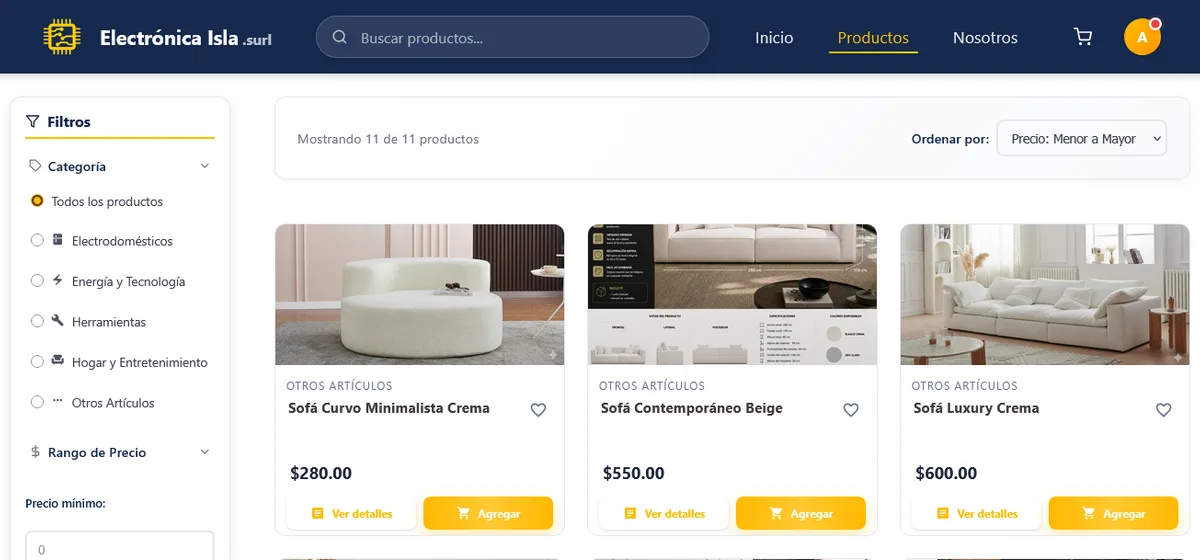
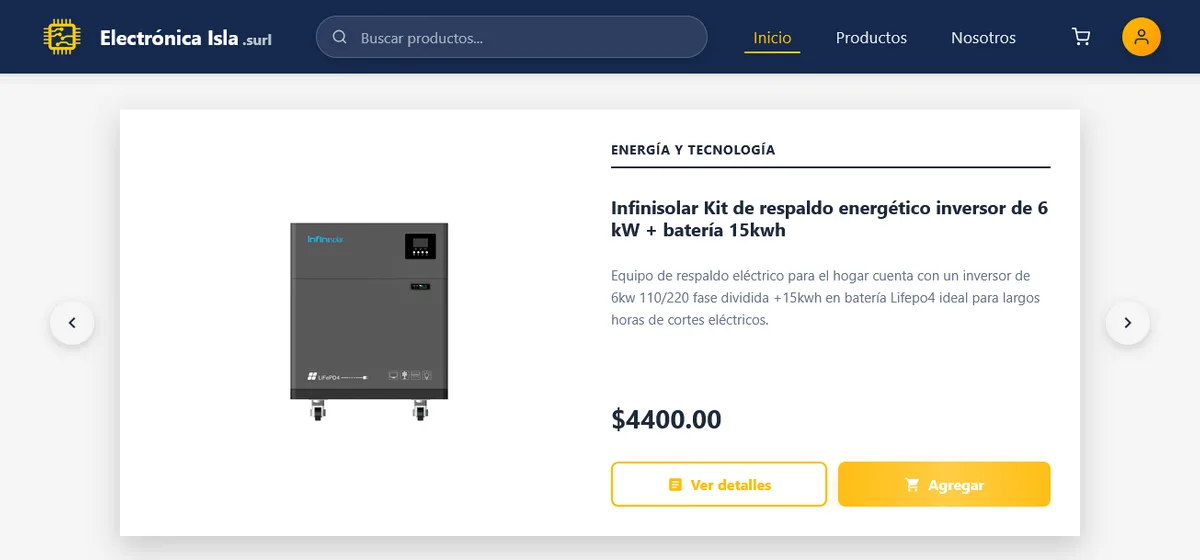
- Catalog by category —appliances, power and tech, tools, home and entertainment— available at any hour.
- Real search and filters: by category, by price range and sorted by price. Someone looking for a fridge under 800 dollars gets there in two clicks.
- Favorites list, to save what caught their eye and decide without rushing.
- Three ways to pay, chosen around how people actually buy: TropiPay for those in Cuba, Zelle for transfers from the United States, and international cards for everyone else.
- Automatic invoicing: every purchase leaves its receipt, with nobody writing it.
- Inventory control: stock goes down on its own, so nothing sells twice.
- Customer accounts, to follow an order without having to ask where it stands.
- Internal wallet, to handle balance and refunds inside the store itself.
- SSL encryption across the whole payment process.
The dashboard that runs it all
Behind the store there is a custom admin dashboard. It is the piece that keeps the business from depending on me, or on anyone technical, to work day to day:
- Products and inventory kept apart. What you offer is one thing; what is left in the warehouse is another. A product can be switched off without being deleted.
- Orders that flag themselves. Pending ones mark up in the menu, so none gets forgotten.
- Refunds, wired to the wallet: the balance goes back without moving money outside.
- Users and roles. Everyone signs in with their own account and sees only their part.
- Stats and reports, filtered by period: users, products, orders and income for the month, or for whatever range you pick.
- History of what happens across the system.
The numbers, ready to file
This is the part you cannot see from the outside, and it is the one that weighs most. The dashboard does not just say how much was sold: it says it the way it has to be filed.
- Tax figures split the way the tax office asks for them: money received from confirmed payments, confirmed sales from delivered orders, and cancellations on their own.
- A unique ID per operation, so any sale can be traced in an audit.
- Monthly close with its own breakdown.
- Sales by day, by product and by payment method, in a table and in a chart.
- Free date range: any period can be pulled up, not just the current month.
A business does not only need to sell. It needs to be able to prove what it sold, when, and how it got paid. That is normally done by hand, at the end of the month, with a spreadsheet and patience.
The month-end close that happens by itself
Every month the owner gets a PDF in his inbox with everything invoiced and a summary of the business. He does not have to open the dashboard, export anything, or remember. It arrives, and that is it.
This is what I mean when I talk about automating: it is not one more feature of the system, it is a task somebody did by hand every month and that now nobody does.
Where you notice it
The owner stopped being the bottleneck. Every order used to pass through his hands: confirm the price, charge, write it down, tell the warehouse, and at the end of the month sit down to square the numbers. Now the store makes that trip on its own and he spends his time on what actually needs a person: advising whoever does not know which fridge to buy.